

Negative electricity prices arise when supply exceeds demand. With the increasing expansion of renewable energies, this issue is becoming particularly relevant for operators of photovoltaic systems when the systems are taken off the grid during periods of negative electricity prices. In Germany, there is no longer a feed-in tariff during these periods. In addition, the billing period is changed from hourly to quarter-hourly.

Negative electricity prices mean that electricity suppliers have to pay to have their electricity taken off the grid. This happens when demand is low but supply is high and the grid cannot absorb any more electricity. This phenomenon occurs, for example, when strong winds and sunshine produce an abundance of electricity, but there is insufficient storage capacity or export options available. In such cases, large photovoltaic systems, for example, are curtailed or taken off the grid altogether, because otherwise they would have to pay for the purchase of their electricity and would push the electricity price even further into negative territory with their supply.
Negative electricity prices mostly occur at midday and from April to September
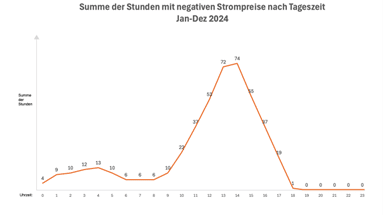
Negative electricity prices follow certain patterns. During the course of the day, they frequently occur in the German grid between 10:00 and 17:00, with a peak between 12:00 and 15:00. (Figure 1)
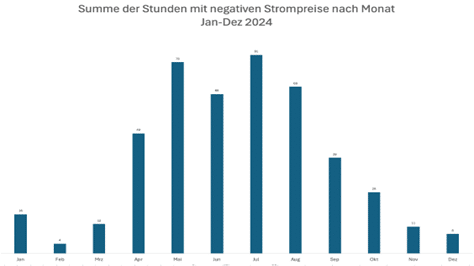
Over the course of the year, most hours with negative electricity prices occur between April and September. Both the distribution by hour during the day and the distribution by month show a clear meteorological correlation: solar radiation is most intense at midday, and April to September are the sunniest months of the year. (Figure 2).
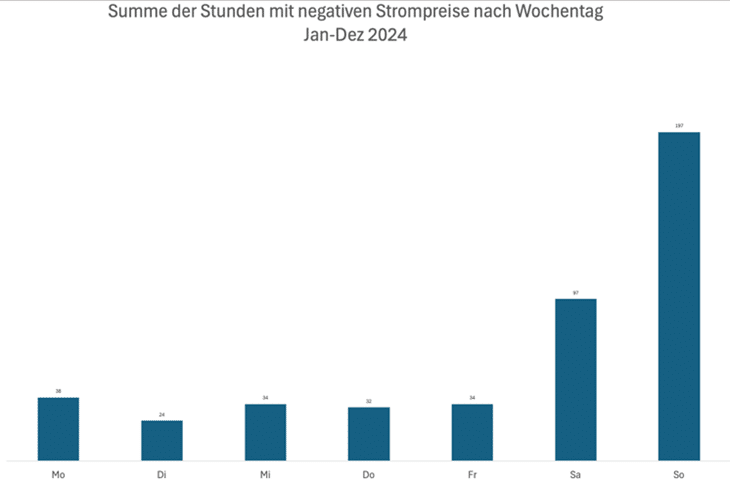
Looking at the distribution of negative electricity prices across the days of the week, Saturdays and Sundays are particularly affected because less work is done on these days and large consumers do not need energy. Grids are then more quickly overloaded and photovoltaic systems are shut down more often. (Figure 3).
Legislative amendment ends feed-in tariffs in times of negative electricity prices
In order to meet the challenges of negative electricity prices, the German Bundestag passed a new law on 31 January, which was approved by the Bundesrat on 14 February. Among other things, the Renewable Energy Sources Act (EEG) adjusts the regulations on remuneration for renewable energy systems in times of negative electricity prices:
- The entitlement to remuneration in the event of negative prices for new plants is to be abolished in principle. In order to determine the electricity volumes for which remuneration is not payable, the installation of a smart metering system is mandatory.
- With the conversion of the official spot market price to quarter-hourly values, remuneration will also be abolished from the first quarter-hour onwards in the event of negative prices.
- In future, grid operators will not have to compensate new installations for lost remuneration in the event of curtailment. During periods of negative electricity prices, plant operators can then consume the electricity themselves or store it temporarily in a storage facility.
- Any lost subsidy periods will be added to the 20-year remuneration period. This will continue to be the case in future, guaranteeing investment security. However, a new formula for adding PV will be introduced, which is intended to take better account of seasonal differences in photovoltaic electricity production than before.
Countermeasures: electricity storage and vertical agri-PV
Negative electricity prices pose an economic challenge for operators of photovoltaic systems, as their systems are often curtailed during these periods. However, effective countermeasures can be taken through targeted planning:
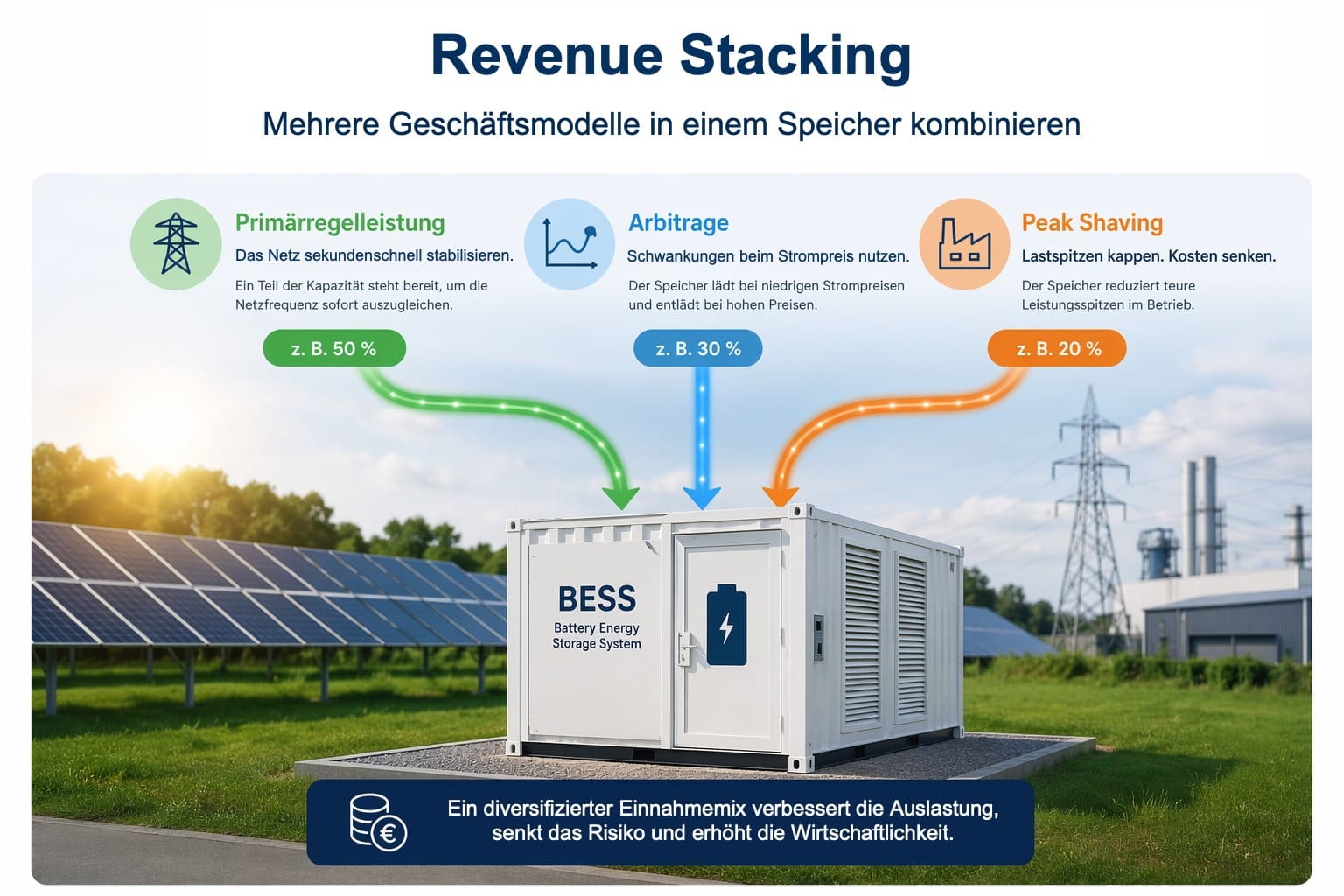
Integrated electricity storage systems can store surplus electricity and then feed it back into the grid when demand rises again.
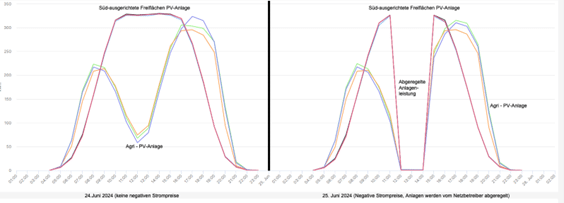
Adapted PV design: An alternative to the classic south-facing orientation of PV systems is vertical agri-PV. This generates peak output in the morning at around 8 a.m. and in the afternoon at around 6 p.m., while delivering less output between 11 a.m. and 2 p.m. – the times when electricity prices are negative. This significantly reduces dependence on unfavourable market prices.
A comparison of the original performance curves of a south-facing ground-mounted system and a vertical agri-PV system from Dutch project developer Profinergy B.V. clearly shows the advantages of this design.
Innovative solutions improve economic efficiency and acceptance
Negative electricity prices are a challenge for operators of photovoltaic systems, especially if they are tied to the market price. A combination of storage solutions integrated into solar parks and a vertical agri-PV design helps to effectively counteract this and significantly improve the economic efficiency of a system. As the electricity market develops towards more and more renewable energies, innovative solutions for times of high supply and negative electricity prices are playing an increasingly important role in sustainably improving the profitability and acceptance of renewable energy systems. Profinergy B.V. has already successfully implemented the above-mentioned solutions and is available for enquiries.
Would you like to learn more about the possibilities of batteries and agri-PV in the United Kingdom? Contact our Business Development Manager:
Christian Steinberg
Business development manager Germany
Mobile: + 49 175 5943143
E-mail: christian@profinrg.com