

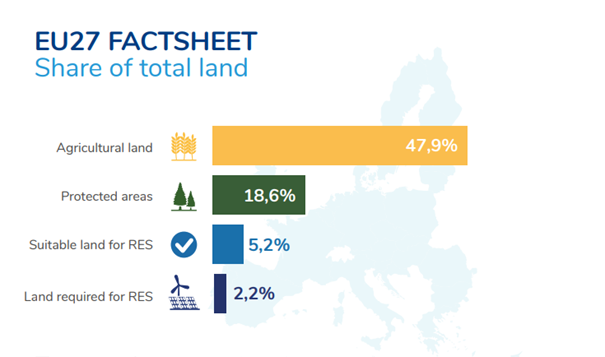
Even when strict agricultural, environmental and biodiversity constraints, buffer zones and technical factors are taken into account, 5.2% of the EU's land area is suitable for onshore wind and solar energy projects, the European Environmental Bureau concludes in the report Land for Renewables. Only 2.2 per cent of the European Union's available land is needed for solar and wind projects for a climate-neutral EU by 2040.
The European Commission's Joint Research Centre previously found that European member states have a potential of 12,400 terawatt hours for both solar and wind energy in rural areas. This is based on selecting areas with the right technical characteristics, namely land with sufficient solar radiation, proximity to the existing road network and avoidance of north-facing slopes. The Joint Research Centre excludes land that has rich biodiversity or high agricultural value.

What are the challenges?
However, the development of solar and wind projects faces challenges. A key aspiration of these projects is that solar farms - like onshore wind - preserve and restore nature, rather than putting further pressure on it.
Changes in land use can lead to conflicts in local communities, so the project must also take their needs into account. Convincing citizens of new developments remains a challenge. Technical complications such as grid connection issues, permitting procedures and that requirements differ between countries and regions are also challenges.
A European network
The European Renewable Energy Directive requires member states to map their territory and identify potential and available land to install sufficient renewable energy sources and electricity grids. Member states must also have land available for acceleration areas for renewable energy projects.
Because some countries have hardly any available land for renewable energy generation, such as Germany and Italy, while others have a lot of available land, namely Spain and Romania, a European grid is emphasised. This will allow countries with surplus energy to send it to neighbouring countries, offsetting energy inequalities and reducing the curtailment of renewables.
Requirements for solar farms (on land) and onshore wind farms
The project targets man-made landscapes and degraded land with limited agricultural value. Other excluded landscapes are Natura 2000 areas. Natura 2000 represents important biodiversity areas, high-quality natural farms and protected areas.
Solar parks require sufficient solar radiation, a reasonable proximity of 5 kilometres from the existing road network and avoidance of north-facing slopes as it makes a difference how the panels are placed. Buffer areas around residential settlements (of 700 metres) and industrial estates (of 500 metres) are also considered.
Land-based wind has mainly the same exclusions and distance criteria as land-based solar panels. Areas with severe orographic conditions with a slope of more than 2.1 degrees are also not for application. As well as land with good wind conditions with a capacity factor of more than 20 per cent are preferred.
Germany
Germany has spatial constraints for onshore wind farms. Although the report states that improved intra- and international grid connections will allow access to the offshore wind hub in the North Sea. However, they do have sufficient land capacity for solar farms.
The report states that clear criteria and better policies are needed for facilitating agri-PV systems. This can help soak up more solar energy because solar panels over crops present better as it can cool up to 10 degrees Celsius more.
Nevertheless, the report concludes that the focus should be on artificial land. This is because solar parks do not always improve biodiversity and, unfortunately, agri-PV is difficult to get profitable without government support.
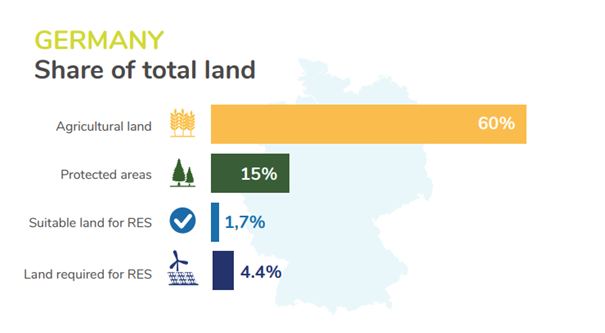
Other challenges include consistency between the planning laws of different states: prioritising PV projects on artificial land, industrial areas and land facing severe degradation problems. As a result, on paper, only 1.7 per cent of Germany's land area is suitable for wind and solar power generation, while 4.4 per cent is needed.
Spain
Spain already has enough suitable land to accommodate the full capacity needed for solar and wind power generation by 2040. The land suitable for solar farms is 5.7 per cent of Spain's total land area. Only 2.6 per cent of Spain's total land is needed for wind and solar farms, without encroaching on areas of high biodiversity or agricultural value.
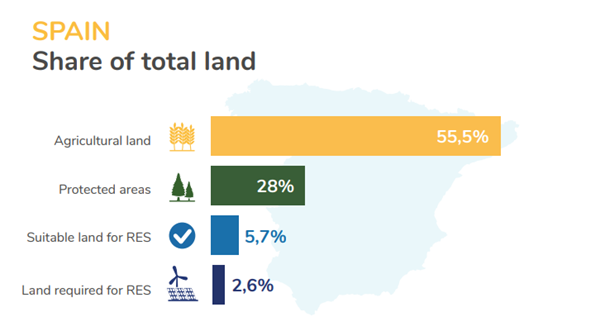
The report suggests that Spain institutes high and consistent public participation due to growing local resistance. One solution is to reduce environmental safeguards for accelerated designation of renewable energy generation areas. The express environmental processing mechanisms have also led to projects being developed in sensitive areas.
Netherlands
The Netherlands was not included as a case study in the study by the European Environmental Bureau, but nature is also under pressure in the Netherlands, and here too, solar farms can increase but also decrease this pressure. Therefore, nature-inclusive solar power is crucial, especially as 54 per cent of Dutch soil is used for agriculture, above the European average of 47 per cent.
On top of that, about a quarter of the land in the Netherlands (26 per cent) is protected area, also above the European average of 18.6 per cent. This also limits the areas available for installation of solar and wind farms.
The development of rooftop solar panels, solar farms and onshore wind farms has the potential to breathe new life into certain areas by supporting the local economy and creating jobs. The report is optimistic that Europe has enough land to generate renewable energy without jeopardising food production or natural ecosystems.
All in all, the available land area should be tailored to the needs and competences of each EU country, based on the geographical, economic and social context of rural areas that will enhance both the effectiveness of the project and the support. However, international cooperation is crucial for accelerating the transition to clean energy.
Source: https: https://www.solar365.nl/


