

Agri-PV enables the simultaneous use of arable land for electricity generation and agriculture. Special installations – either vertical rows of modules or overhead systems – leave enough space for agricultural use. With the ‘Solar Package 1’ (May 2024), agri-PV, floating PV and car park PV were recognised as ‘special photovoltaic systems’ that enjoy special privileges. We explain what these are and why in the text.
Fundamental advantages of agri-PV
In addition to the dual benefits of electricity and agricultural production, all areas covered by agri-PV also retain their agricultural privileges. The prerequisite is that the installed photovoltaic system does not restrict agricultural use by more than 15 per cent.
Vertical agri-PV
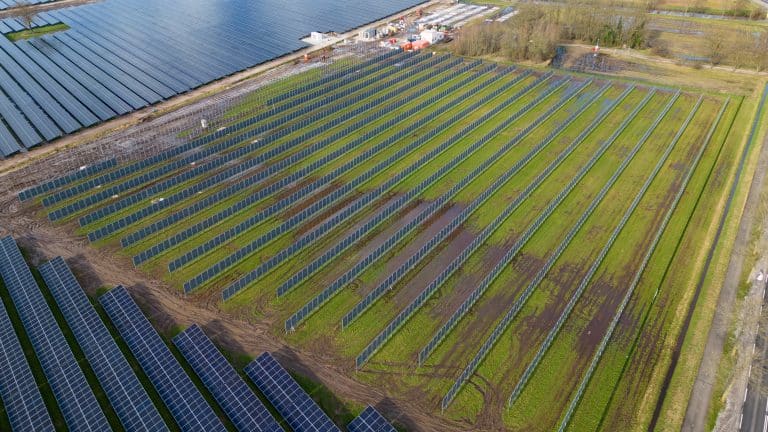
Systems with bifacial PV modules installed vertically in an east-west direction achieve high yields, especially in the early morning and late afternoon. At midday, when classic roof and ground-mounted systems achieve peak performance, the output of vertically installed east-west systems decreases. Vertical agri-PV systems thus complement the production of traditional systems and relieve the burden on the electricity grid. In addition, the loss in the event of disconnection from the grid by the grid operator is significantly lower than with a conventional ground-mounted system. Read also: Live data shows the potential
‘Overhead’ agri-PV
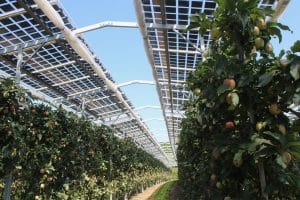
In overhead agri-PV, the modules are installed on a substructure several metres above the agricultural area. This means that the area under the modules can still be used for growing fruit and vegetables or for animal husbandry and can be worked by machine. In addition, the photovoltaic modules protect the area below from the effects of weather, sun, rain, hail, etc. In Germany, a minimum height of 2.10 metres is required for this type of system.
Higher yields with ‘tracking’ agri-PV
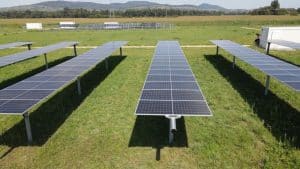
A special variant of agri-PV are tracking systems, which follow the sun's path and thus achieve a higher electricity yield. Such systems are available in various designs: as ‘overhead’ systems, as agri-PV in rows or as large-scale tracking systems in which entire module fields are tracked in several axes.
If the area is used for agricultural purposes, the systems can be moved into a parking position to facilitate cultivation. Overhead systems do not require this step, as their modules do not interfere with agricultural work.
Agri-PV in use: synergies for maximum efficiency in Almelo
Since 2023, a 1.9 MW vertical agri-PV system has been generating sustainable solar power on around 3.2 hectares in Almelo, the Netherlands. The system was planned and installed by Profinergy B.V. from Utrecht on behalf of Klimaatfonds Nederland and is also operated by Profinergy.
In Almelo, the vertical agri-PV system is part of a hybrid system and complements a significantly more powerful, south-facing classic ground-mounted photovoltaic system.
Find out how vertical agri-PV compares to classic ground-mounted systems, what advantages it offers, how both systems work together optimally and what impact disconnecting the system from the grid has when electricity prices are negative in our live report: Live data shows the potential.


