



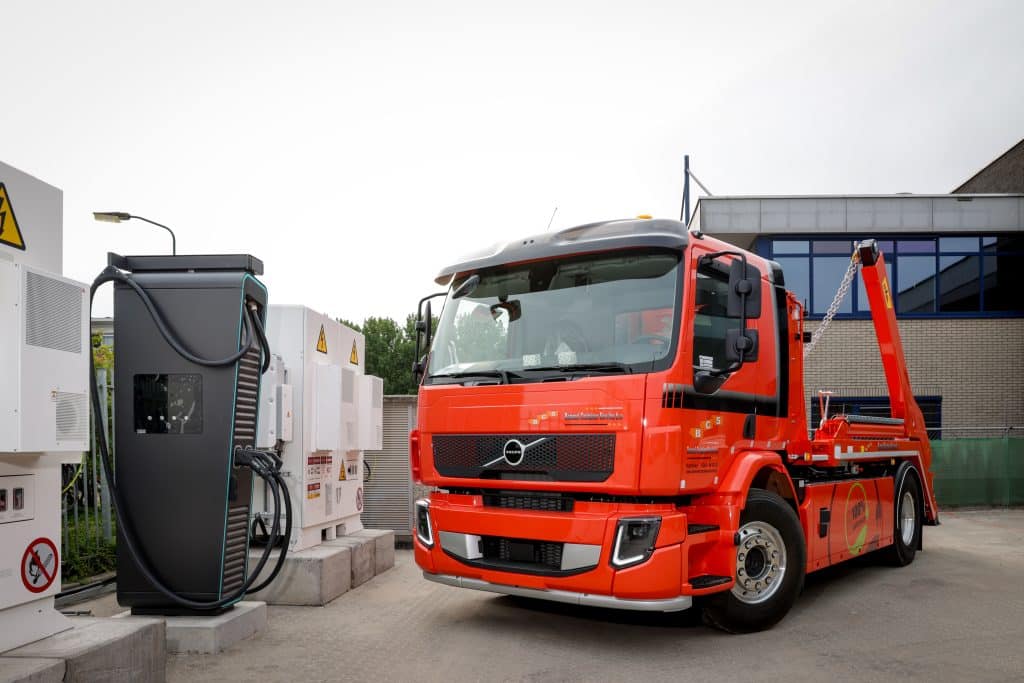
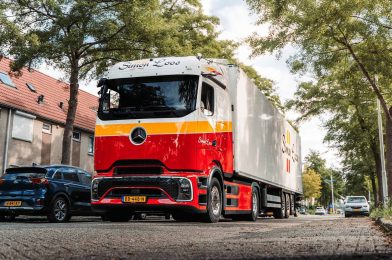
There are those for whom diesel, so to speak, runs through their veins. And yet even those lorry drivers don’t want anything else once they’ve got used to an electric lorry. ‘It’s just like with passenger cars: super-fast acceleration, less vibration and it’s dead quiet. People really do come home less tired after a day’s work on the road,’ says Wim Roks, fleet manager at logistics provider Simon Loos.
The family-run business he works for placed a second order for 75 Mercedes-Benz lorries at the end of last year and, with 210 vehicles, will soon likely have the largest electric lorry fleet in the Netherlands. For it is not just the drivers who have come round; customers and – not unimportantly – the finance department have now also embraced the heaviest e-trucks.
A small gap between the Tesla Semi and European lorries
So when Tesla unveils its Semi at the IAA transport trade fair in Germany, the American EV pioneer will, in fact, be arriving late. Unlike Tesla’s passenger cars, which were launched in Europe with a technical lead of many years, the gap between the Tesla Semi and, say, a Volvo FH Electric or Mercedes eActros is only small. Under favourable conditions, those can also cover 600 kilometres in practice. Moreover, according to hauliers and automotive experts, the Semi is not yet available in a version suitable for Europe. It’s too long, too wide – and would a single-seater cab really go down well with our lorry drivers?
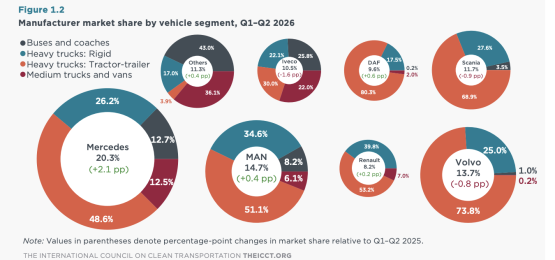
But that is a theoretical question for the time being. It is far more interesting to find out how the rise of electric lorries in Europe is actually progressing. Does Simon Loos have colleagues and competitors who are just as enthusiastic about the electrification of heavy goods transport?
The Netherlands is leading the way with electric lorries
Taking a step back: sales of electric passenger cars are on the rise – that much is well known. Delivery vans and light goods vehicles used for urban distribution are also increasingly battery-powered. According to the latest figures from the International Council on Clean Transportation, 75 per cent of new vans and light trucks were electric in the second quarter of 2026. This makes the Netherlands the frontrunner in Europe, ahead of Sweden and Denmark, with Germany trailing some way behind.
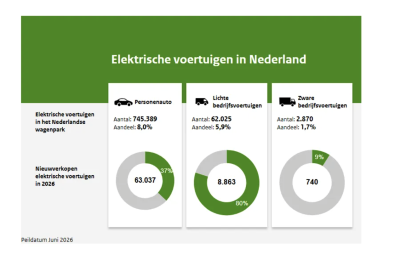
That same picture – the Netherlands as the frontrunner – can be seen in the heaviest category of commercial vehicles, weighing over 15 tonnes. Here, however, battery-powered vehicles are considerably less common, accounting for 9 per cent of sales. However, prior to 2025, less than 3 per cent of new lorries were electric, which represents a threefold increase compared with 2024. There are now more than 2,800 heavy-duty electric lorries on the roads in the Netherlands.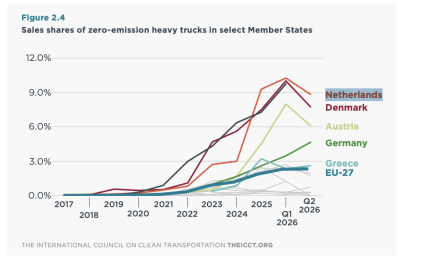
Zero-emission zones are giving e-trucks a boost
That relative success in the Netherlands is easily explained, says Maarten Steinbuch, who, as Professor of Systems and Control Engineering at Eindhoven University of Technology, closely follows developments in automotive electrification. ‘The zero-emission zones in cities are a key pillar. These have, of course, given a huge boost to electric transport, although this applies particularly to vans and lighter lorries. It has really created a ripple effect.’
Moreover, Steinbuch argues that, in general terms, the Netherlands was already leading the way in charging infrastructure, which is another key prerequisite for the success of electric transport. In the international transport sector, organisations such as Milence – founded by major lorry manufacturers – are working on an ultra-fast charging network across Europe.
Finally, the government is offering transport companies a purchase subsidy for the heaviest lorries. Unlike the average electric car, these require a considerably higher investment: around 3 tonnes, compared with less than one and a half tonnes for a diesel lorry.
AanZET grant and lorry charge
To help the transport sector get started, there is the Zero-Emission Trucks Purchase Subsidy Scheme (AanZET) for lorries weighing over 10 tonnes, which can amount to well over 115,000 euros. ‘In that respect, you could say that the e-truck is now at the stage that the EV was at in 2015: a bit of a helping hand is still needed to encourage their uptake. For passenger cars, the assessment at the time was that subsidies would no longer be needed by 2025, and they are indeed being phased out. For lorries, incentives will be needed until at least 2030.’
See also: Anja van Niersen is paving the way for electric lorries with Milence
In this regard, much is also expected from the new lorry charge that came into force on 1 July. Lorry owners will then pay a charge per kilometre driven, on almost all motorways and on some regional and local roads. The cleaner and lighter the vehicle, the lower the charge per kilometre. Compared with an old diesel lorry, this could save more than 10 cents per kilometre.
‘The good thing about this is that the revenue – expected to be 400 million euros a year – will be partly reinvested in the transport sector itself, through investment in charging infrastructure and purchase subsidies,’ says Steinbuch. ‘Electrification is self-financing.’
Incidentally, larger companies receive less subsidy per lorry. But that hasn’t put the brakes on electrification at Simon Loos, says fleet manager Roks. ‘And we receive the subsidy for about one in ten of the lorries we purchase each year. But as far as we’re concerned, we’re not particularly in favour of subsidies either: we’d rather see the money invested in upgrading the electricity grid.’
‘It’s almost impossible not to like it’
Roks has completely changed his mind, but that didn’t happen overnight, he explains. ‘If you have a background in automotive engineering, as many people in my line of work do, you weren’t enthusiastic about electric driving from day one – and that certainly applies to the Wim Roks of 30 years ago. But these days, it’s almost impossible not to be in favour of it. Even people at other companies who have long turned a blind eye are now being presented with the figures on their desks: shouldn’t we start driving electric vehicles?’
Even so, he and his company were early adopters. ‘Our client Heineken approached us in 2008 asking how we could help them reduce their carbon footprint. Carbon footprint? I’d never heard of it at the time – and I don’t think many others had either. Couldn’t we start using electric lorries for them in the cities?’
Converting lorries to electric power
Electric lorries didn’t exist back then. However, a company was found that could convert new lorries to electric power. To do this, the entire diesel powertrain was removed and replaced with an electric motor and batteries. ‘A bit of a waste of capital, really. But those eight lorries are still on the road.’
‘Later on, manufacturers introduced electric models. Initially, these weren’t quite as robust as diesel models, which have 80 years of development behind them. But they’ve quickly caught up, partly because their best people jump straight in whenever something isn’t working properly. Make no mistake: things can always go wrong, which is why, as a haulier, you don’t so much choose a particular make as a dealer network you can rely on for service and maintenance. And now, 12 years after the first electric lorries hit the road, we’re set to make the switch for our general haulage operations.’
Electricity was 40 per cent more expensive
Simon Loos has, in fact, vehicles that operate for several customers, and vehicles that dedicated for, say, a supermarket or catering businesses on the move. In the past, these contributed to the additional costs of electric driving during those pioneering days. ‘We charge an hourly rate that covers all costs. In the beginning, electric vehicles were actually 30 to 40 per cent more expensive – costs that we factored into the rate. So, as a client, you really had to want it.’
Now, certainly since the introduction of the lorry tax and the high price of diesel, driving an electric vehicle is often cheaper than sticking with diesel. And in a market operating on razor-thin margins, it’s all about that famous TCO – the total cost of ownership. ‘E-trucks last at least 8 years and 1 million kilometres, and as long as you cover enough kilometres and have cheap electricity, the tipping point has already been reached.’
Huge battery makes your own charging point indispensable
But whilst a fleet owner might want to make the switch, it must also be feasible. The latest heavy-duty trucks can travel up to 600 kilometres, but consume 1 kWh per kilometre – more than ten times as much as a passenger car. Consequently, they are fitted with formidable battery packs that need to be recharged with hundreds of kilowatt-hours every day. The Mercedes-Benz eActros 600 has a 621 kWh battery pack and currently charges at a rate of 400 kWh per hour.
Anyone who has their own charging points – preferably with solar panels that provide cheaper electricity – is sitting pretty. ‘Our lorries that operate for customers are also charged at the customer’s premises; we hardly ever see them here at our head office in Wognum. And customers often have their charging capacity well organised, usually at their distribution centre.’ But it’s true, says Roks, he has customers who can’t drive electric vehicles because they’re unable to install charging points due to a lack of grid capacity.
Network congestion threatens to become a hindrance
‘We’d like to start driving electric vehicles from Wognum too, but we still need to work out how we’re going to organise that for ourselves. The local energy company says there’s no capacity on the grid until 2038.’ For Simon Loos, this is a challenging project, but Roks takes a pessimistic view of the future for transport companies if the shortage of electricity connections in the Netherlands is not resolved. ‘Then, in many sectors, companies will no longer be able to compete. In that respect, the government really needs to act quickly to prevent the sector from suffering.’
Professor Steinbuch from Eindhoven does not see grid congestion as a major obstacle to the rise of electric lorries. ‘That is not an issue, certainly not in the long term. Companies need to be more creative with their power supply; with solar panels and batteries, it’s usually possible to make the most of existing capacity. As far as I’m concerned, electric cars or lorries aren’t a problem, but rather one of the solutions to the energy transition – after all, they act as energy buffers.’
Lorry as a mobile energy buffer
Thanks to V2G (vehicle-to-grid) technology, electric vehicles can not only charge themselves but also feed electricity back into the grid. Seen in this light, a lorry actually acts as an energy storage system ten times larger than a car. ‘We need to manage the Dutch electricity supply in a much more decentralised way. A neighbourhood can benefit from electric cars and lorries when setting up such a local energy system; this would prevent grid congestion. It also represents a new revenue model for the lorry owners.’
Long distances remain a challenge
It can all be sorted out and needn’t hold back the roll-out of electric lorries. It’s only on long-haul routes that there are still some challenges to work out, say hauliers. Milence’s charging network, featuring Megawatt Charging Systems capable of charging a lorry with over 1,000 kW, is still a long way from being complete.
This spring, the scale-up raised a further 120 million euros to roll out its services further; it now has 34 ‘hubs’ in 8 countries. People joke that the company makes more money from the croquettes sold at its stations than from electricity. Steinbuch: ‘It’s similar to the situation with EVs ten years ago; back then, Fastned was also heavily criticised, but now it’s taking off.’
Wasn’t hydrogen supposed to be the solution for heavy goods transport over long distances? That’s a thing of the past, says Steinbuch. ‘If you don’t have to use it, then it’s best not to. It’s complex, and it takes so much energy to produce and transport that it isn’t worth it.’
Source: mt/sprout
This article was written by

 Nederlands
  English (UK)
  Deutsch